
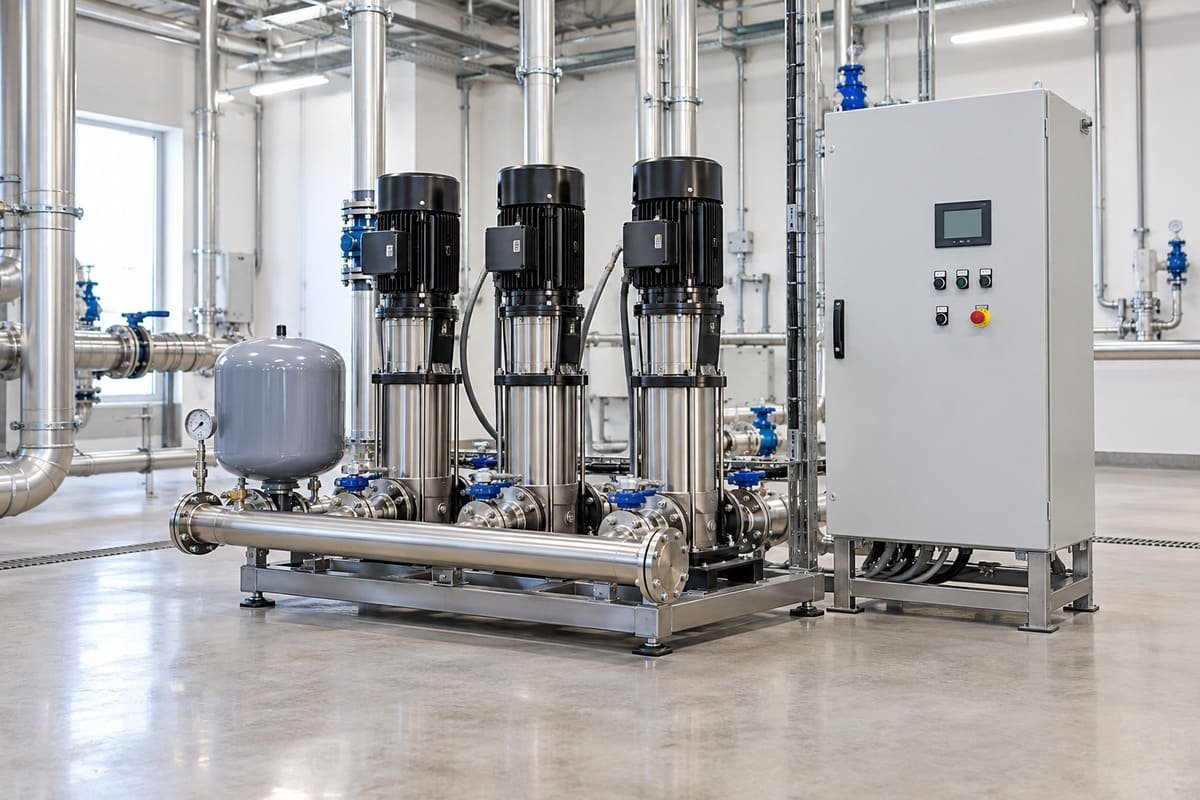
In many pump systems the demand changes through the day. A fixed-speed pump handles that by throttling or by switching on and off, wasting energy and stressing the pipework. A variable-frequency pump changes its speed to match the demand, which holds the pressure steady and uses far less power at part load.
How variable speed works
A frequency converter (VFD) changes the frequency of the power supplied to the motor, and so the speed. A pressure sensor in the pipe tells the controller what the system needs. If demand falls, the pump slows down; if demand rises, it speeds up, keeping the pressure at the set point.
Why it saves energy: the affinity laws
For a centrifugal pump, flow changes in proportion to speed, head with the square of speed, and power with the cube of speed. Running at 80 percent speed uses only about half the power (0.8 cubed is roughly 0.51). Because most systems run at part load most of the time, the savings add up quickly.

Other benefits
- Constant pressure at every outlet, with no pressure swings.
- Soft starting, which reduces water hammer and electrical stress.
- Lower noise at part load.
- Longer life for seals, bearings and pipework.
- Protection functions such as dry-run, over-current and over-pressure.
CNP examples: CHME and TDE
The CHME is a complete constant-pressure unit: a horizontal multistage pump supplied with its frequency controller, pressure sensor, check valve, pressure gauge and tank. The TDE is a vertical single-stage in-line pump with the controller built in, which holds constant pressure or temperature difference and can run several pumps together.
When it pays back
Variable speed pays back fastest where demand varies widely and the pump runs many hours: building water supply, district cooling, industrial circulation and irrigation. It is less useful where the pump runs at a fixed duty all the time. Estimate the savings from the duty profile before deciding.
What to check before you specify
Make sure the pump's minimum flow is respected, the motor is suitable for inverter duty, the cable length is within the VFD's limits, and the system pressure never exceeds the pipe rating.
Frequently asked questions
How much energy can a VFD pump save?
It depends on the duty profile. Systems that run mostly at part load can cut pump energy by a third or more compared with throttled fixed-speed control.
Do all motors work with a frequency converter?
Most modern motors do, but check the insulation class and bearing protection, especially with long cables.
Can one controller run several pumps?
Yes. Multi-pump controllers stage and rotate the pumps and run one or more on variable speed to follow demand.
Talk to CNP Pumps Pakistan
See the CHME and TDE ranges, or tell us your demand profile and we will estimate the savings.


Comments
No comments yet. Be the first to write one.