

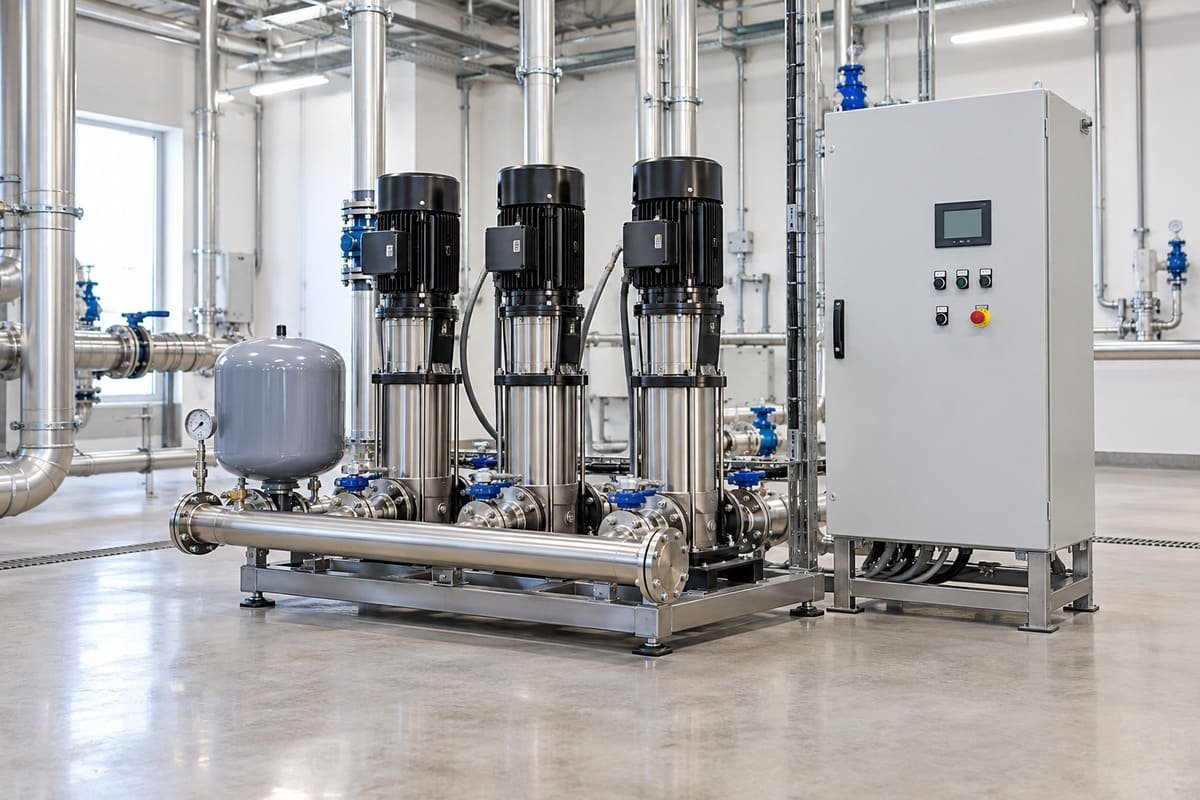
A vertical multistage pump stacks several impellers on one shaft inside a slim, upright body. Each impeller adds pressure, so a compact pump can deliver a high head from a small footprint. That is why it is the usual choice for water boosting, reverse osmosis feed, washing systems and boiler feed across Pakistan's factories, buildings and farms.
How a vertical multistage pump works
Water enters at the base, passes through the first impeller and diffuser, then moves up to the next stage. At every stage the liquid gains pressure, and the final stage sends it to the outlet. The motor sits on top and drives the shaft directly, so the pump needs very little floor space and is quiet in operation.
Because pressure is added stage by stage, the same pump casing can be built with more or fewer stages. Doubling the stages roughly doubles the head at the same flow. In a CNP model code such as CDL32-40-2, the figures tell you the rated flow and the number of stages, so you can read the duty directly from the name.
Main parts and materials
- Impellers and diffusers – stamped stainless steel for smooth flow passages and high efficiency.
- Outer sleeve and shaft – stainless steel in the all-stainless versions, for clean or mildly aggressive liquids.
- Mechanical seal – the shaft seal that keeps water in the pump; choose the seal material for the liquid and temperature.
- Base and head – cast iron or stainless steel depending on the series.
- Motor – a standard IP55 motor, usually two-pole, on a direct coupling.
CNP builds vertical multistage pumps in several families. The CDL and CDLF range suits general clean-water duty, the CDM range is a newer energy-saving design, CDLK is an immersion type for tanks and machine tools, and LDMF handles hot water and low inlet pressure.

Where vertical multistage pumps are used
- Pressure boosting for buildings, hotels, hospitals and housing societies.
- Reverse osmosis and water treatment as feed or transfer pumps.
- Industrial washing and cleaning lines in food, textile and automotive plants.
- Boiler feed and hot-water circulation with the hot-water versions.
- Irrigation, sprinklers and livestock water where steady pressure is needed.
- Cooling and air-conditioning circuits that need a high head at moderate flow.
What to check before you choose
First, collect the duty: the flow you need in m³/h and the total head in metres, including pipe friction and the height you must lift. Second, note the liquid, its temperature and whether it contains any solids. Third, confirm the electrical supply (50 Hz three-phase is standard) and the space you have.
Then pick a model whose rated point is close to your duty, ideally near the best-efficiency point on its curve. A pump that is far too large wastes energy and wears faster; one that is too small cannot reach the head. If you are unsure, enter your flow and head in the CNP Pump Finder and compare the closest models side by side.
Frequently asked questions
What is the difference between CDL and CDM pumps?
Both are vertical multistage pumps. The CDL family is a light, general-purpose range, while the CDM family is a newer, energy-saving design built to European standards. Check each model's curve and datasheet for your exact duty.
Can a vertical multistage pump run dry?
No. The mechanical seal is lubricated by the pumped water, so running dry quickly damages the seal. Use a dry-run or low-pressure protection device on automatic systems.
Is a vertical multistage pump suitable for hot water?
Standard models are rated for water up to a stated temperature; hot-water versions such as LDMF are built for higher temperatures. Always confirm the maximum liquid temperature for your model.
Talk to CNP Pumps Pakistan
Browse the full CDL / CDLF and CDM ranges, or send us your duty point and our engineers will confirm the right model.


Comments
No comments yet. Be the first to write one.